CASES Conference 2026 poster presentation
Michelle presented her research on developing pedagogical confidence to support pupils with ADHD in primary school PE at CASES Conference 2026 in Manchester.
The poster presentation shared work from her research with primary PE teachers, exploring how pedagogical confidence develops in practice and how school contexts shape inclusive support for pupils with ADHD.
This poster reflects the work as presented at CASES Conference 2026, and the published abstract reflects the poster presentation. A full paper has since been written and is currently under peer review, so the framing and emphasis may differ slightly as the work has progressed.
Jump to practical tips for PE teachers
Conference poster
Poster
Developing pedagogical confidence to support pupils with ADHD in primary school PE
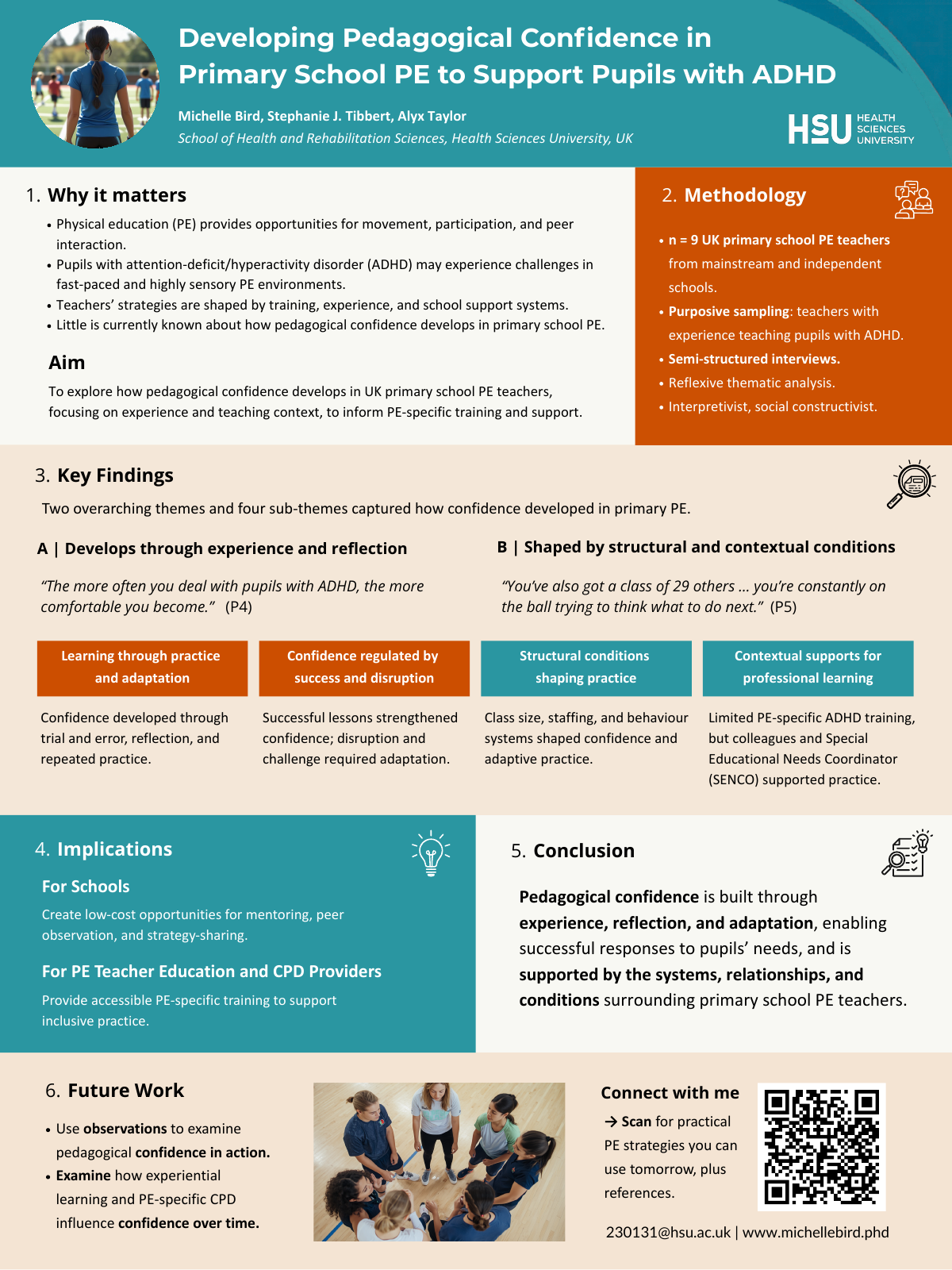
Michelle presented this poster at CASES Conference 2026 in Manchester.
View or download poster PDFPublished abstract
The conference abstract has been published in the Journal of Sports Sciences.
Read the Journal of Sports Sciences abstract
Bird, M., Tibbert, S. J., & Taylor, A. (2026). D2.P36 Developing pedagogical confidence to support pupils with attention-deficit/ hyperactivity disorder (ADHD) in primary school physical education (PE). Journal of Sports Sciences, 44(sup1), 127.
Practical tips for PE teachers
These practical actions are drawn from the research study and focus on helping pupils with ADHD feel supported in PE lessons.
- Reduce waiting time. Plan activities so pupils spend more time moving and less time standing in lines, where attention can drift and frustration can build.
- Reduce the pressure of competition. Adjust scoring, teams, or rules when the competitive element is making it harder for a pupil to manage emotions.
- Give pupils space when they are struggling. Use a quieter area, a smaller group, or a short reset so pupils can regulate emotions and rejoin the activity.
- Use demonstration to support attention. Show the activity and use brief prompts or visual cues so pupils can see what to do without relying only on verbal instructions.
- Use predictable routines for transitions. Keep starts, stops, equipment changes, and group changes clear so pupils know what to do next.
- Talk to colleagues about what works. Share observations with PE colleagues and support staff so useful strategies can be repeated and adapted.
Poster References
- Bandura, A. (1997). Self-efficacy: The exercise of control. W. H. Freeman.
- Braun, V., & Clarke, V. (2022). Thematic analysis: A practical guide. SAGE Publications.
- Rudd, J. R., Woods, C., Correia, V., Seifert, L., & Davids, K. (2021). An ecological dynamics conceptualisation of physical "education": Where we have been and where we could go next. Physical Education and Sport Pedagogy, 26(3), 293–306. https://doi.org/10.1080/17408989.2021.1886271.
- Szép, A., Dantchev, S., Zemp, M., Schwinger, M., Chavanon, M.-L., & Christiansen, H. (2021). Facilitators and barriers of teachers' use of effective classroom management strategies for students with ADHD: A model analysis based on teachers' perspectives. Sustainability, 13(22), Article 12843. https://doi.org/10.3390/su132212843.
- Villa-de Gregorio, M., Palomo-Nieto, M., Gomez-Ruano, M. A., & Ruiz-Perez, L. M. (2023). Attentional neurodiversity in physical education lessons: A sustainable and inclusive challenge for teachers. Sustainability, 15(6), Article 5603. https://doi.org/10.3390/su15065603.
- Vygotsky, L. S. (1978). Mind in society: The development of higher psychological processes (M. Cole, V. John-Steiner, S. Scribner, & E. Souberman, Eds.). Harvard University Press.
- Wilson, C., Green, C. N., Toye, M. K., & Ballantyne, C. (2024). Teachers' perceptions and practices towards inclusive education for children with ADHD in Scotland: A qualitative investigation. International Journal of Disability, Development and Education, 71(7), 1061–1075. https://doi.org/10.1080/1034912X.2023.2266374.